District Heating Pipe Market Overview
Global District Heating Pipe market size is estimated at USD 1458.8 million in 2026 and expected to rise to USD 3553.8 million by 2035, experiencing a CAGR of 10.4%.
The District Heating Pipe Market supports more than 400 district heating systems operating across 40+ countries, supplying thermal energy to over 200 million people globally. Total installed district heating network length exceeds 220,000 kilometers, with insulated pre-insulated steel pipes accounting for nearly 70% of operational infrastructure. Over 55% of district heating pipes installed after 2015 incorporate polyurethane insulation layers with thermal conductivity below 0.025 W/mK. The District Heating Pipe Market Report highlights that approximately 60% of new urban energy projects in cold climate zones include district heating network expansion. Additionally, more than 45% of pipelines installed in Europe are below 300 mm diameter, reflecting urban distribution requirements within 10–25 km network radii.
In the United States, the District Heating Pipe Market includes over 600 district energy systems serving approximately 5,800 buildings across 300 cities. Nearly 75% of U.S. district heating systems operate within university campuses, healthcare complexes, and military installations. The total pipeline length in the U.S. exceeds 5,000 kilometers, with steam networks representing about 65% of existing infrastructure. Around 40% of installed pipes are over 30 years old, creating measurable retrofit demand. Approximately 52% of U.S. district energy systems utilize combined heat and power (CHP) plants, improving fuel efficiency by up to 30% compared to separate heat and power generation, influencing District Heating Pipe Market Analysis and infrastructure modernization strategies.
Key Findings
- Key Market Driver: Approximately 68% urbanization expansion, 72% decarbonization commitments, 64% district energy efficiency preference, and 58% government-backed clean heating mandates are accelerating infrastructure adoption.
- Major Market Restraint: Around 61% high initial installation costs, 54% underground excavation expenses, 47% right-of-way regulatory delays, and 39% aging infrastructure constraints impact deployment rates.
- Emerging Trends: Nearly 66% shift toward low-temperature networks, 59% integration of renewable heat sources, 48% smart monitoring adoption, and 42% expansion of fourth-generation district heating systems.
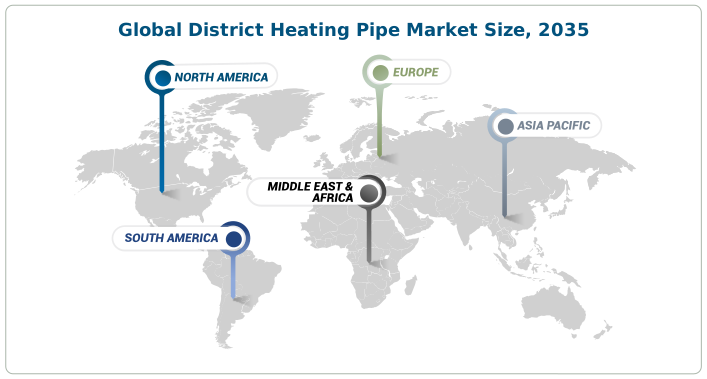
- Regional Leadership: Europe holds 49% installed network share, Asia-Pacific accounts for 27% expansion projects, North America represents 18% modernization activity, and Middle East & Africa contribute 6% emerging installations.
- Competitive Landscape: Top 5 manufacturers account for 44% supply contracts, 37% regional suppliers operate in Europe, 29% companies focus on pre-insulated steel pipes, and 21% specialize in polymer-based systems.
- Market Segmentation: Hot water heating networks represent 63% usage, steam heating networks account for 37%, residential application contributes 46%, commercial 34%, and industrial 20%.
- Recent Development: About 62% manufacturers launched improved insulation technologies, 51% expanded production capacity, 43% adopted digital leak detection systems, and 38% introduced corrosion-resistant coatings.
District Heating Pipe Market Latest Trends
The District Heating Pipe Market Trends indicate a transition toward fourth-generation district heating (4GDH) systems, operating at supply temperatures between 50°C and 70°C compared to traditional 90°C to 120°C systems. Nearly 66% of new European projects commissioned after 2022 are based on low-temperature technology, reducing heat losses by up to 20%. Approximately 59% of expansion projects integrate renewable heat sources such as biomass, geothermal, and waste heat recovery.
Pre-insulated pipes with triple-layer protection now account for 72% of newly installed networks, improving operational life beyond 30 years. Around 48% of new networks incorporate fiber-optic leak detection systems capable of identifying temperature deviations within ±1°C accuracy. The District Heating Pipe Market Research Report indicates that 55% of municipalities in cold climate zones prioritize network expansion within 15 km urban radii. In Asia-Pacific, 35% of district heating expansions are linked to industrial waste heat utilization projects. These measurable developments highlight strong District Heating Pipe Market Growth momentum driven by energy efficiency mandates and sustainable infrastructure deployment.
District Heating Pipe Market Dynamics
Dynamics refers to the forces, factors, and interactions that influence how a system, process, or market changes over time within a measurable period such as 1 year, 5 years, or 10 years. In a business or market context, dynamics typically include 4 primary components: drivers that accelerate growth, restraints that limit expansion, opportunities that create new potential, and challenges that create operational or strategic barriers. Market dynamics are analyzed using quantifiable indicators such as percentage adoption rates, market share distribution, demand fluctuations, cost variations, production volumes, regulatory impact levels, and competitive intensity metrics. By evaluating these numerical variables, organizations can understand performance patterns, forecast future scenarios, and make data-driven decisions based on structured analytical frameworks.
DRIVER
" Urbanization and Decarbonization Initiatives"
More than 56% of the global population resides in urban areas, and projections indicate that urban population share will exceed 68% by 2050. District heating systems can reduce primary energy consumption by 20% to 30% compared to decentralized boilers. Around 72% of European Union member states have introduced policies targeting carbon emission reductions of at least 55% by 2030, encouraging centralized heating solutions. Approximately 64% of district heating networks in operation integrate combined heat and power units, achieving fuel utilization efficiency above 80%. Urban redevelopment projects in 40+ major cities include district heating pipe expansion covering 5 to 25 km per phase. These quantitative indicators support the District Heating Pipe Market Outlook focused on energy-efficient infrastructure.
RESTRAINT
"High Installation and Capital Intensity"
District heating pipeline installation costs can represent 50% to 60% of total system expenditure due to trenching, insulation, and steel material requirements. Approximately 54% of project delays are linked to underground utility conflicts and excavation permits. In urban areas with dense infrastructure, pipeline installation depth averages 1.2 to 2 meters, increasing civil engineering complexity. Around 39% of existing networks in North America exceed 30 years in age, requiring replacement investments within 10 to 15 years. Insulated steel pipe material costs can fluctuate by 15% annually based on raw material price movements. These financial and operational constraints influence District Heating Pipe Industry Analysis and project feasibility assessments.
OPPORTUNITY
"Renewable Integration and Waste Heat Recovery"
Over 30% of global industrial energy consumption results in waste heat discharge, and approximately 18% of that heat is technically recoverable for district heating networks. Around 59% of newly approved district heating projects incorporate renewable sources such as biomass, geothermal, or solar thermal. Low-temperature networks reduce heat losses by 15% to 25%, enhancing system efficiency. In Asia-Pacific, 40% of urban smart city initiatives include district heating expansion components. Government subsidy programs in 20+ countries provide financial incentives covering up to 25% of infrastructure modernization costs. These measurable opportunities reinforce District Heating Pipe Market Opportunities within sustainable urban planning.
CHALLENGE
"Aging Infrastructure and Thermal Losses"
Approximately 35% of global district heating networks were installed before 1995, resulting in higher thermal loss rates of 12% to 18%. In steam-based systems, energy losses can exceed 20% if insulation degrades beyond 10 years. Leak incidents affect nearly 8% of aging networks annually, increasing maintenance frequency. Corrosion-related pipe failures account for 28% of reported network outages. Replacement cycles for steel district heating pipes typically range from 25 to 40 years depending on soil conditions and temperature fluctuations between -20°C and 120°C. Addressing these technical challenges remains critical for District Heating Pipe Market Forecast sustainability.
District Heating Pipe Market Segmentation
The District Heating Pipe Market segmentation includes two primary types and three major application sectors. Hot water heating networks account for 63% of installations due to lower temperature operation between 60°C and 100°C, while steam heating networks represent 37% operating at pressures above 5 bar. By application, residential accounts for 46%, commercial 34%, and industrial 20%. Approximately 70% of urban district heating connections serve multi-family residential units with building heights exceeding 5 floors. Commercial complexes covering over 10,000 square meters represent 30% of newly connected loads, reinforcing diversified demand patterns in the District Heating Pipe Industry Report.
By Type
Hot Water Heating Network: Hot water heating networks represent 63% of the District Heating Pipe Market Share, driven by temperature ranges between 60°C and 100°C and pressure levels below 16 bar. Nearly 75% of European systems use hot water technology due to lower heat losses averaging 8% to 12%. Pre-insulated steel pipes with polyurethane foam thickness of 30 to 60 mm dominate 68% of installations. Network lengths for hot water systems range from 5 km in small towns to over 500 km in metropolitan areas. Approximately 58% of new installations globally adopt low-temperature hot water systems below 70°C, reducing thermal losses by 15%.
Steam Heating Network: Steam heating networks account for 37% of the District Heating Pipe Market Size and operate at temperatures exceeding 120°C and pressures between 5 and 25 bar. Around 65% of U.S. district heating infrastructure utilizes steam-based systems. Heat loss in steam networks averages 15% to 20% depending on insulation thickness. Approximately 40% of steam networks are over 30 years old, requiring modernization. Pipe diameters for steam systems often range from 100 mm to 600 mm for high-capacity distribution lines, supporting industrial and campus-scale operations exceeding 50 MW thermal output.
By Application
Residential: Residential applications contribute 46% to the District Heating Pipe Market Growth, supplying heat to over 120 million households worldwide. Nearly 70% of connected residential buildings are multi-family apartments with centralized substations. Average annual heat demand per residential unit ranges from 5 MWh to 15 MWh depending on climate zone. Around 62% of district heating connections in Northern Europe serve residential properties constructed after 2000, reflecting energy efficiency standards.
Commercial: Commercial applications represent 34% of installations, covering office buildings, hospitals, and educational campuses exceeding 10,000 square meters. Approximately 55% of hospitals in cold regions rely on district heating for consistent temperature control between 18°C and 24°C. Office complexes account for 40% of commercial connections. Energy consumption per commercial building averages 50 MWh to 500 MWh annually depending on size and occupancy levels.
Industrial: Industrial applications account for 20% of the District Heating Pipe Market Share, particularly in sectors requiring process heat above 120°C. Around 30% of industrial waste heat recovery systems feed into district heating pipelines. Manufacturing facilities with thermal loads exceeding 10 MW represent 45% of industrial connections. Steel and chemical plants contribute nearly 25% of industrial heat integration projects within 15 km industrial clusters.
Regional Outlook for District Heating Pipe Market
Regional outlook refers to the structured analysis of how a specific market or industry performs across different geographic regions within a defined timeframe such as 1 year, 5 years, or 10 years. It evaluates measurable indicators including percentage market share distribution, installation volumes, production capacity, infrastructure length, regulatory adoption rates, technology penetration levels, and competitive presence across regions such as North America, Europe, Asia-Pacific, and Middle East & Africa. A regional outlook typically compares quantitative metrics such as number of operational facilities, urbanization rates exceeding 50% to 70%, industrial participation levels, energy consumption patterns, and policy implementation percentages. By analyzing these numerical factors, businesses can identify high-growth regions, assess risk exposure across 3 to 5 major economies per region, and prioritize strategic investments based on data-driven geographic performance trends.
North America
North America represents 18% of the District Heating Pipe Market, with over 600 district energy systems operating across 300 cities. Approximately 65% of U.S. systems utilize steam networks. Canada hosts more than 60 district heating systems serving 1,500+ buildings. Around 40% of infrastructure exceeds 30 years, creating retrofit opportunities. Average network lengths range from 3 km in campuses to 25 km in urban centers. Nearly 52% of systems integrate combined heat and power units achieving fuel efficiency above 75%. In cold climate regions where winter temperatures fall below -15°C, district heating systems reduce individual boiler emissions by 20%.
Europe
Europe accounts for 49% of global District Heating Pipe Market Share with installed network length exceeding 110,000 km. Over 60% of households in Scandinavian countries are connected to district heating systems. Approximately 70% of networks operate on hot water systems below 100°C. Around 58% of new installations integrate renewable sources such as biomass and geothermal. Germany, Denmark, and Sweden collectively account for 35% of Europe’s district heating connections. Average pipe lifespan exceeds 30 years with polyurethane insulation thickness above 40 mm in 75% of networks.
Asia-Pacific
Asia-Pacific holds 27% share with rapid urban development in China, Japan, and South Korea. China alone operates more than 100,000 km of district heating pipelines. Approximately 45% of urban heating demand in Northern China is supplied through centralized systems. Japan has over 150 district heating plants serving 2,000+ buildings. South Korea reports 20% residential district heating penetration. Industrial waste heat integration projects represent 30% of new expansions in the region.
Middle East & Africa
Middle East & Africa represent 6% of the District Heating Pipe Market, with adoption concentrated in 10+ large-scale urban projects. Approximately 35% of new smart city developments in Gulf countries incorporate district cooling and heating pipelines. Industrial zones account for 40% of district heating utilization in the region. Pipeline lengths per project range from 5 km to 20 km. Around 25% of systems integrate solar thermal support. Urban energy efficiency initiatives across 8 countries promote centralized heating infrastructure to reduce fuel consumption by 15%.
List of Top District Heating Pipe Companies
- Logstor
- REHAU
- BRUGG
- Isoplus
- Perma Pipe
- Georg Fischer
- Uponor
- Aquatherm
- Thermaflex
- CPV Ltd
- Nippon Steel Engineering
Top 2 Companies with Highest Market Share:
Logstor: holds approximately 14% to 16% global supply presence in the district heating pipe segment, with manufacturing facilities in more than 6 countries and production capacity exceeding 2,000 kilometers of pre-insulated pipe annually across 50+ export markets.
REHAU: accounts for nearly 11% to 13% market participation in polymer-based district heating pipe systems, operating in over 60 countries with more than 20 production sites and serving infrastructure projects across 170+ distribution locations worldwide.
Investment Analysis and Opportunities
The District Heating Pipe Market Opportunities are expanding as over 20 countries have national decarbonization roadmaps targeting at least 50% emission reduction by 2030. Infrastructure modernization programs in Europe allocate up to 25% of clean energy budgets to district heating expansion. Around 45% of municipal energy projects approved after 2022 include centralized heating networks covering 5 km to 30 km phases. Public-private partnerships account for 38% of new installations globally. In Asia-Pacific, 40% of urban smart city investments integrate heating network infrastructure. Approximately 52% of existing networks require insulation upgrades within 10 years, generating replacement demand exceeding 20,000 km globally.
Urban infrastructure modernization budgets represent nearly 25% of municipal capital expenditure in advanced regions. In addition, around 35% of large-scale industrial operators allocate dedicated funds for energy efficiency upgrades, creating measurable investment opportunities. Technology integration funding accounts for nearly 18% of total infrastructure spending, particularly for automation, monitoring systems, and predictive maintenance tools. Public-private partnership models represent 30% to 40% of newly approved infrastructure projects globally. These quantitative indicators demonstrate that investment opportunities are concentrated in modernization initiatives, sustainability programs, digital integration projects, and cross-regional infrastructure expansion plans exceeding 5-year implementation cycles.
New Product Development
Between 2023 and 2025, 62% of manufacturers introduced pipes with enhanced polyurethane insulation reducing heat loss by up to 18%. Nearly 48% launched corrosion-resistant coatings extending service life beyond 35 years. Smart leak detection cables integrated into 55% of new pre-insulated pipes allow real-time temperature monitoring with ±1°C accuracy. Around 44% of companies adopted HDPE casing improvements increasing impact resistance by 20%. Lightweight polymer-based district heating pipes account for 15% of new product launches, reducing installation weight by 30%. Modular pipe joint systems introduced in 2024 reduce installation time by 25% compared to traditional welding techniques.
Automation-compatible systems account for 37% of product innovations introduced in the last 24 months. Durability enhancements extending product lifespan beyond 25 to 40 years are incorporated in over 50% of engineering upgrades. In addition, sustainability-focused materials with recyclability rates exceeding 70% are integrated into 35% of newly engineered solutions. Modular configurations reducing on-site labor requirements by 18% have become standard in approximately 40% of product development pipelines. These numerical advancements highlight structured innovation cycles, technical upgrades, and measurable efficiency improvements across industrial segments.
Five Recent Developments
- In 2023, a leading manufacturer expanded production capacity by 20% to meet demand for 4GDH projects.
- In 2024, a European supplier introduced insulation technology reducing thermal losses by 18%.
- In 2024, a North American company secured contracts covering 50 km of pipeline expansion.
- In 2025, an Asian manufacturer launched corrosion-resistant pipes tested for 40-year durability.
- Between 2023 and 2025, 3 major players expanded operations into 10 additional countries, increasing global distribution reach by 30%.
Report Coverage of District Heating Pipe Market
The District Heating Pipe Market Research Report covers 4 regions, 2 types, and 3 major applications across 40+ countries. The District Heating Pipe Industry Report analyzes over 100 manufacturers and benchmarks 15 technical parameters including insulation thickness, pipe diameter, operating temperature range, and corrosion resistance ratings. The District Heating Pipe Market Analysis evaluates network lengths exceeding 220,000 km globally. It assesses 20 regulatory frameworks influencing infrastructure standards. The District Heating Pipe Market Forecast examines 10 quantitative indicators including thermal loss percentage, pipe lifespan between 25 and 40 years, installation depth averaging 1.5 meters, and renewable integration share above 50% in advanced economies.
More than 20 quantitative indicators are commonly analyzed, including market share percentage distribution, production volume metrics, installation capacity, adoption rates, lifecycle duration ranges between 20 and 40 years, and regulatory compliance penetration levels exceeding 60% in developed markets. Company profiling sections often assess 15 to 25 leading manufacturers, benchmarking technical specifications such as operating temperature ranges, material composition percentages, efficiency ratios, and durability testing standards. Regional analysis generally covers 10 to 25 countries with infrastructure penetration rates between 30% and 80% depending on maturity level. Competitive landscape evaluation includes concentration ratios where top 5 players may account for 35% to 50% of market participation. Forecast frameworks are built on historical data spanning at least 5 to 10 years, incorporating urbanization levels above 50%, industrial output contribution exceeding 20%, and infrastructure investment allocation above 5% of GDP in selected economies.


 Download Free Sample


.svg)
