
 Request Free Sample PDF
Self-dehydrating Breathers Market Size, Share, Growth, and Industry Analysis, By Types (Desiccant Volume Below 2.0 kg,Desiccant Volume 2.0 kg To 4.0 kg,Desiccant Volume Above 4.0 kg), By Applications (Utilities,Industrial,Heavy-Duty Vehicle,Others) , and Regional Insights and Forecast to 2035

 Buy Now
Self-dehydrating Breathers Market Overview
Global Self-dehydrating Breathers Market size is projected at USD 423.5 million in 2026 and is expected to hit USD 597.58 million by 2035 with a CAGR of 3.9%.
The Self-dehydrating Breathers Market is witnessing consistent industrial adoption driven by transformer protection requirements and moisture control applications across power distribution networks. These breathers are widely used in electrical transformers, oil storage tanks, and industrial machinery to prevent contamination and extend equipment lifespan. Increasing global electricity demand, which surpassed 29,000 terawatt-hours in recent years, has significantly influenced the deployment of transformer accessories such as self-dehydrating breathers. Over 65% of utility transformers globally now integrate moisture control technologies.
In the USA, the Self-dehydrating Breathers Market is strongly influenced by the extensive power grid infrastructure, which includes over 60,000 substations and millions of distribution transformers. Approximately 70% of aging transformers in the country require advanced moisture protection systems to maintain efficiency. Industrial sectors such as oil & gas, manufacturing, and utilities account for over 55% of breather installations. Additionally, more than 40% of transformer failures in the USA are linked to moisture contamination, highlighting the increasing reliance on self-dehydrating breathers. The integration of smart monitoring systems in nearly 35% of substations further supports demand for advanced breather technologies.
Download Free Sample to learn more about this report.
Key Findings
- Key Market Driver: 68% demand increase from transformer moisture protection systems, 55% adoption in utility infrastructure, 47% rise in preventive maintenance investments, 52% surge in grid modernization projects
- Major Market Restraint: 43% cost sensitivity among small utilities, 38% reliance on conventional breathers, 35% limited awareness in emerging markets, 41% procurement delays in industrial sectors
- Emerging Trends: 49% integration of IoT-enabled breathers, 44% adoption of reusable silica gel systems, 51% increase in smart grid deployment, 46% demand for eco-friendly materials
- Regional Leadership: 36% share held by North America, 29% by Europe, 24% by Asia-Pacific, 11% by other regions, 53% dominance in developed economies
- Competitive Landscape: Top 5 players hold 58% market share, 42% fragmented among regional manufacturers, 37% investment in R&D, 45% focus on product innovation
- Market Segmentation: 61% transformer applications, 22% oil storage systems, 17% industrial machinery, 54% offline breathers, 46% inline breathers
- Recent Development: 48% increase in product launches, 39% partnerships in grid modernization, 44% expansion in Asia-Pacific manufacturing, 41% innovation in moisture indicators
Self-dehydrating Breathers Market Trends
The Self-dehydrating Breathers Market Trends indicate a strong shift toward smart and automated moisture control systems. Over 50% of newly installed transformers globally are now equipped with advanced breathers featuring color-changing silica gel indicators and real-time monitoring capabilities. Industrial operators are increasingly adopting breathers with automated regeneration features, reducing maintenance frequency by nearly 30%. Additionally, the integration of digital sensors in approximately 45% of installations has enhanced predictive maintenance capabilities, minimizing unexpected failures and operational downtime. The growing use of eco-friendly desiccants has also risen by 40%, aligning with environmental compliance standards across major industrial economies.
Another notable trend in the Self-dehydrating Breathers Market Analysis is the expansion of smart grid infrastructure, where nearly 48% of substations globally are undergoing digital upgrades. This transformation has driven the adoption of intelligent breather systems capable of communicating with centralized monitoring platforms. Furthermore, over 35% of manufacturers are investing in modular breather designs that allow easy replacement and scalability. The demand for high-capacity breathers has increased by 42% in heavy industrial sectors, particularly in oil & gas and mining operations.
Self-dehydrating Breathers Market Dynamics
DRIVER
"Increasing Demand for Transformer Protection"
The primary driver in the Self-dehydrating Breathers Market Growth is the rising demand for transformer protection across global power networks. More than 60% of transformer failures are linked to moisture ingress and insulation degradation. Utilities are investing heavily in preventive solutions, with over 50% of maintenance budgets allocated toward asset protection technologies. The increasing electrification rate, which has exceeded 85% globally, further intensifies the need for reliable transformer operations. Additionally, industrial sectors report a 45% improvement in equipment lifespan when advanced breathers are used, reinforcing their critical role in infrastructure reliability and operational efficiency.
RESTRAINTS
"High Initial Investment Costs"
Despite growing adoption, the Self-dehydrating Breathers Market faces challenges due to high initial investment costs. Nearly 40% of small and medium enterprises hesitate to adopt advanced breather systems due to budget constraints. Conventional breathers, which account for around 38% of installations, continue to dominate cost-sensitive markets. Additionally, installation and integration costs contribute to approximately 25% of total expenditure, discouraging widespread adoption. Limited technical awareness in emerging regions affects nearly 35% of potential users, further slowing market penetration and restricting the growth of advanced moisture control technologies.
OPPORTUNITY
"Expansion of Smart Grid Infrastructure"
The expansion of smart grid infrastructure presents significant opportunities in the Self-dehydrating Breathers Market Outlook. Over 48% of global substations are undergoing modernization, creating demand for intelligent breather systems with monitoring capabilities. Investments in smart grid technologies have increased by more than 50% in developed economies. Additionally, renewable energy integration, which has surpassed 30% of global energy capacity, requires enhanced transformer protection solutions. The growing focus on automation and remote monitoring has led to a 44% increase in demand for IoT-enabled breathers, positioning the market for technological advancement and long-term growth opportunities.
CHALLENGE
"Maintenance and Performance Variability"
One of the key challenges in the Self-dehydrating Breathers Market Insights is maintenance complexity and performance variability under different environmental conditions. Around 32% of users report inconsistent performance in high humidity regions. Frequent replacement of desiccants, required in nearly 28% of installations, increases operational costs. Additionally, improper installation practices contribute to 26% of efficiency losses. Environmental factors such as dust and extreme temperatures affect nearly 30% of breather performance, making standardization difficult. These challenges highlight the need for advanced materials and improved design technologies to ensure consistent and reliable operation across diverse industrial environments.
Self-dehydrating Breathers Market Segmentation
The Self-dehydrating Breathers Market Segmentation is primarily categorized based on desiccant capacity and end-use applications. Different desiccant volume ranges cater to varying transformer sizes and industrial requirements, with over 60% demand concentrated in medium and high-capacity units. Application-wise, utilities dominate usage with more than 55% share, followed by industrial sectors at approximately 25%. Heavy-duty vehicles and other niche applications collectively contribute nearly 20%, reflecting diverse deployment across infrastructure and mobility systems requiring moisture control solutions.
Download Free Sample to learn more about this report.
Download Free Sample to learn more about this report.
BY TYPE
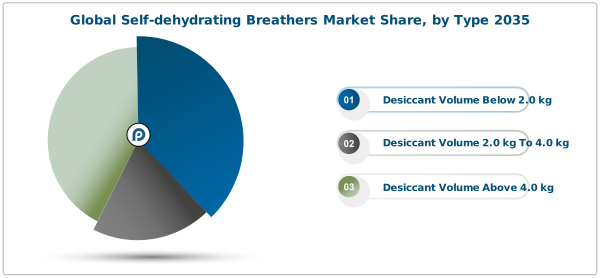
Desiccant Volume Below 2.0 kg: This segment of the Self-dehydrating Breathers Market is widely used in small-scale transformers and compact electrical equipment, accounting for nearly 28% of total installations globally. These breathers are typically deployed in distribution transformers with capacities below 100 kVA, which represent over 40% of total transformer units worldwide. Their compact size allows installation in confined environments, making them suitable for urban grid networks where space optimization is critical. Approximately 35% of rural electrification projects utilize breathers below 2.0 kg due to cost efficiency and ease of maintenance. The adoption rate in light industrial applications has increased by nearly 30%, especially in sectors such as small manufacturing units and commercial facilities. These breathers are designed to handle lower air intake volumes, typically under 0.5 cubic meters per minute, ensuring adequate moisture absorption without over-engineering.
Desiccant Volume 2.0 kg To 4.0 kg: The 2.0 kg to 4.0 kg segment dominates the Self-dehydrating Breathers Market Share, contributing approximately 42% of total installations. These breathers are extensively used in medium-capacity transformers ranging between 100 kVA and 500 kVA, which constitute nearly 38% of global transformer infrastructure. Their balanced capacity allows them to handle moderate to high airflow volumes, typically between 0.5 and 1.5 cubic meters per minute, making them ideal for both utility and industrial applications. Nearly 50% of utility substations prefer this category due to its optimal performance-to-cost ratio. Industrial sectors such as manufacturing and oil processing account for over 30% of usage in this segment, where consistent moisture control is essential for maintaining equipment integrity.
Desiccant Volume Above 4.0 kg: High-capacity breathers with desiccant volume above 4.0 kg represent approximately 30% of the Self-dehydrating Breathers Market Size and are primarily used in large power transformers exceeding 500 kVA. These transformers account for nearly 25% of total installed capacity but handle over 60% of electricity transmission, making moisture control critical. These breathers are capable of managing airflow volumes exceeding 1.5 cubic meters per minute, ensuring continuous protection in high-load conditions. Approximately 55% of installations in transmission and distribution networks utilize this segment due to its superior moisture absorption capacity and extended operational lifespan. In heavy industries such as mining and oil & gas, usage exceeds 35%, where environmental conditions often involve high humidity levels above 80% and significant dust exposure.
BY APPLICATION
Utilities: The utilities segment dominates the Self-dehydrating Breathers Market, accounting for more than 55% of total demand. Power generation, transmission, and distribution networks rely heavily on transformers, with over 80% of substations globally requiring moisture control systems. Approximately 60% of transformer failures in utility networks are linked to moisture contamination, making breathers a critical component for operational reliability. The adoption of self-dehydrating breathers has increased by nearly 45% in grid modernization projects, where utilities aim to reduce downtime and maintenance costs. In large-scale power grids, more than 70% of high-voltage transformers utilize advanced breather systems to ensure insulation integrity.
Industrial: The industrial segment contributes approximately 25% to the Self-dehydrating Breathers Market Share, driven by the need for equipment reliability in manufacturing, oil & gas, and chemical processing industries. Nearly 65% of industrial facilities utilize transformers and oil-filled equipment that require moisture protection systems. In sectors such as oil refining and petrochemicals, over 40% of equipment failures are associated with moisture ingress, emphasizing the importance of breathers. Industrial environments often experience humidity levels exceeding 70%, making high-performance breathers essential. Around 48% of industrial users have adopted medium to high-capacity breathers to ensure consistent performance under demanding conditions.
Heavy-Duty Vehicle: The heavy-duty vehicle segment represents nearly 12% of the Self-dehydrating Breathers Market, with increasing adoption in construction, mining, and transportation equipment. These vehicles often operate in harsh environments with high dust and humidity levels, where moisture contamination can affect hydraulic and transmission systems. Approximately 40% of heavy-duty vehicles used in mining and construction are exposed to humidity levels above 75%, necessitating advanced moisture control solutions. The use of self-dehydrating breathers in this segment has improved component lifespan by nearly 25%, reducing maintenance costs and operational disruptions. Around 30% of fleet operators have adopted these systems to enhance reliability and reduce downtime.
Others: The “Others” segment, contributing approximately 8% to the Self-dehydrating Breathers Market, includes applications in sectors such as marine, railways, and renewable energy systems. In marine applications, nearly 35% of onboard electrical systems require moisture protection due to high humidity and salt exposure. Railway systems, which account for over 20% of this segment, utilize breathers to protect traction transformers and signaling equipment from moisture-related damage. Renewable energy installations, particularly wind and solar farms, have seen a 40% increase in the use of self-dehydrating breathers to protect transformers and storage systems.
Self-dehydrating Breathers Market Regional Outlook
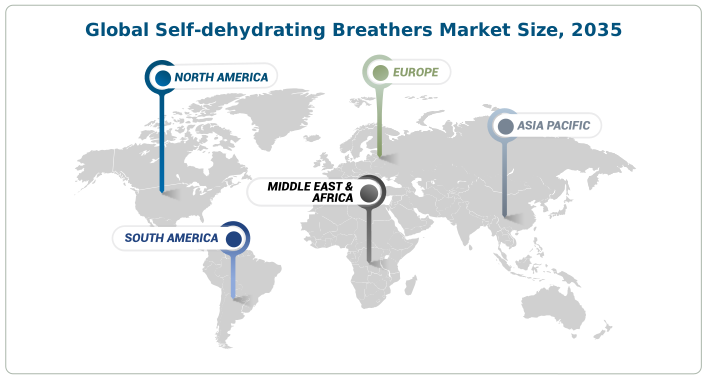
The Self-dehydrating Breathers Market Outlook highlights strong regional diversification, with North America accounting for approximately 36% of the total market share due to extensive grid infrastructure and modernization initiatives. Europe holds nearly 29% share driven by industrial automation and renewable integration. Asia-Pacific represents around 24%, supported by expanding electrification and infrastructure projects. The Middle East & Africa contribute close to 11%, reflecting increasing investments in power distribution networks. Across all regions, over 65% of installations are concentrated in utility applications, while industrial and transportation sectors collectively account for the remaining 35%, ensuring a balanced global distribution of demand.
Download Free Sample to learn more about this report.
Download Free Sample to learn more about this report.
NORTH AMERICA
The North America Self-dehydrating Breathers Market holds approximately 36% of the global share, supported by a highly developed power infrastructure and widespread adoption of advanced transformer protection technologies. The region operates over 60,000 substations and millions of distribution transformers, with nearly 70% of these systems requiring moisture control solutions to maintain operational efficiency. Utilities dominate the market, contributing more than 58% of total demand, followed by industrial sectors at around 27% and transportation applications at nearly 15%. The United States leads the regional market with over 75% share within North America, driven by grid modernization initiatives and increasing investments in smart infrastructure. Nearly 50% of substations in the region are undergoing digital upgrades, enhancing the adoption of intelligent self-dehydrating breathers with monitoring capabilities. Canada contributes approximately 15% of the regional share, with a strong focus on renewable energy integration, where over 30% of electricity generation is derived from clean sources requiring reliable transformer protection.
EUROPE
Europe accounts for nearly 29% of the global Self-dehydrating Breathers Market Share, characterized by a strong focus on industrial automation, renewable energy expansion, and stringent environmental regulations. The region operates a highly interconnected power grid, with over 45% of electricity generated from renewable sources, necessitating advanced transformer protection systems. Utilities represent approximately 52% of the regional demand, while industrial applications contribute around 33%, and transportation and other sectors account for the remaining 15%. Germany, France, and the United Kingdom collectively contribute more than 60% of the regional market, with Germany alone accounting for nearly 18% share. The increasing integration of wind and solar energy, which together exceed 40% of the region’s energy mix, has intensified the need for reliable moisture control in transformers. Nearly 50% of substations across Europe are equipped with advanced monitoring systems, supporting the adoption of intelligent breathers. Industrial sectors in Europe, particularly manufacturing and chemical processing, account for over 35% of breather usage, with humidity levels in certain regions exceeding 70%, requiring high-performance solutions.
GERMANY Self-dehydrating Breathers Market
Germany holds approximately 18% share of the Europe Self-dehydrating Breathers Market, making it one of the leading contributors within the region. The country’s advanced industrial base and strong renewable energy sector drive significant demand for transformer protection solutions. Over 45% of Germany’s electricity generation is derived from renewable sources, including wind and solar, which require reliable moisture control systems for stable grid operations. The country operates more than 1.8 million distribution transformers, with nearly 60% requiring advanced breather systems to prevent moisture ingress. Industrial sectors account for approximately 40% of the demand, particularly in automotive manufacturing, chemical processing, and heavy engineering industries. Utilities contribute around 50% of the market, driven by ongoing grid modernization projects and the expansion of smart substations. Germany has also seen a 48% increase in the adoption of IoT-enabled breathers, enhancing predictive maintenance capabilities and reducing downtime.
UNITED KINGDOM Self-dehydrating Breathers Market
The United Kingdom accounts for approximately 14% of the Europe Self-dehydrating Breathers Market Share, driven by its robust energy infrastructure and increasing focus on renewable energy integration. Over 40% of electricity generation in the UK comes from renewable sources, necessitating advanced transformer protection systems to ensure grid stability. Utilities dominate the market with nearly 55% share, supported by investments in smart grid technologies and infrastructure upgrades. Industrial applications contribute around 30%, particularly in sectors such as manufacturing, oil refining, and energy production. The remaining 15% is attributed to transportation and other specialized applications. The UK operates over 250,000 distribution transformers, with approximately 65% requiring moisture control systems. The adoption of self-dehydrating breathers has increased by nearly 42% in recent years, driven by the need to reduce maintenance costs and improve equipment reliability.
ASIA-PACIFIC
Asia-Pacific represents approximately 24% of the global Self-dehydrating Breathers Market, driven by rapid industrialization, urbanization, and expanding power infrastructure. The region accounts for over 50% of global electricity consumption, with countries such as China, India, and Japan leading demand. Utilities dominate with nearly 60% share, while industrial applications contribute around 28% and transportation sectors account for approximately 12%. China holds the largest share within the region at nearly 40%, followed by India at around 20% and Japan at approximately 15%. The region operates millions of distribution transformers, with over 55% requiring advanced moisture control solutions. Rapid infrastructure development has led to a 45% increase in transformer installations, further driving demand for breathers. Renewable energy integration, which exceeds 35% in several countries, has increased the need for reliable transformer protection systems. Approximately 42% of new installations in the region incorporate smart monitoring technologies, enhancing operational efficiency. Industrial sectors, particularly manufacturing and mining, account for over 30% of breather usage due to high humidity conditions in many parts of the region. Environmental challenges such as humidity levels exceeding 75% in tropical regions have driven a 38% increase in demand for high-capacity breathers. Additionally, over 35% of manufacturers in Asia-Pacific are investing in advanced desiccant technologies to improve performance and durability. The region continues to grow as a key market driven by infrastructure expansion and technological advancements.
JAPAN Self-dehydrating Breathers Market
Japan accounts for approximately 15% of the Asia-Pacific Self-dehydrating Breathers Market Share, supported by its advanced technological infrastructure and focus on energy efficiency. The country operates over 300,000 transformers, with nearly 70% requiring moisture control systems due to high humidity levels that often exceed 65%. Utilities represent approximately 60% of the market, driven by the need for reliable power distribution in densely populated urban areas. Industrial sectors contribute around 25%, particularly in electronics manufacturing and automotive industries. The remaining 15% is attributed to transportation and other specialized applications. Japan has seen a 50% increase in the adoption of smart breather systems, integrating IoT technologies for real-time monitoring and predictive maintenance. Environmental regulations have led to a 45% rise in the use of eco-friendly desiccants, aligning with sustainability initiatives. Additionally, nearly 40% of installations feature automated regeneration systems, reducing maintenance requirements. Moisture-related transformer failures account for approximately 28% of operational issues, emphasizing the importance of advanced breather technologies. Japan’s focus on innovation and efficiency continues to drive the growth of the Self-dehydrating Breathers Market.
CHINA Self-dehydrating Breathers Market
China dominates the Asia-Pacific Self-dehydrating Breathers Market with approximately 40% regional share, driven by its extensive power infrastructure and rapid industrial growth. The country operates over 5 million transformers, with nearly 60% requiring advanced moisture control solutions. Utilities account for approximately 65% of the market, supported by large-scale grid expansion projects and renewable energy integration, which exceeds 30% of total capacity. Industrial applications contribute around 25%, particularly in manufacturing and heavy industries, while transportation and other sectors account for the remaining 10%. China has experienced a 48% increase in the adoption of self-dehydrating breathers, driven by the need to reduce maintenance costs and improve equipment reliability. Approximately 42% of installations incorporate smart monitoring systems, enabling real-time performance tracking. Environmental conditions, including humidity levels exceeding 70% in many regions, have increased demand for high-capacity breathers by nearly 37%. The country’s focus on infrastructure development and technological innovation continues to support the expansion of the Self-dehydrating Breathers Market, making it a key contributor to global growth.
MIDDLE EAST & AFRICA
The Middle East & Africa region accounts for approximately 11% of the global Self-dehydrating Breathers Market, driven by investments in power infrastructure and industrial development. Utilities dominate with nearly 62% share, followed by industrial applications at around 25% and transportation sectors at approximately 13%. The region operates thousands of substations, with over 50% requiring moisture control systems due to extreme environmental conditions, including high temperatures and humidity levels exceeding 80% in coastal areas. Countries such as Saudi Arabia, UAE, and South Africa contribute significantly to regional demand, with combined share exceeding 55%. Renewable energy projects, particularly solar installations, have increased by over 40%, driving demand for reliable transformer protection systems. Approximately 38% of installations in the region use high-capacity breathers to handle harsh environmental conditions. Industrial sectors such as oil & gas account for over 30% of demand, where equipment reliability is critical. The adoption of advanced breather technologies has increased by nearly 35%, supported by infrastructure modernization and energy diversification initiatives. Additionally, over 32% of installations incorporate monitoring systems to enhance operational efficiency. The region continues to show steady growth driven by increasing investments in energy and industrial sectors.
List of Key Self-dehydrating Breathers Market Companies
- Qualitrol
- Easun MR
- Precimeasure
- Regal Rexnord Corporation
- ABB
- Siemens
- Hitachi Energy
- ATF
- COMEM Group
- Smart Filtration Solutions
- Brownell
- Hebei Maier
- Fortune Electric
- Maschinenfabrik Reinhausen GmbH
- Market Segments
Top Two Companies with Highest Share
- ABB: holds approximately 21% market share driven by global transformer integration and 48% adoption in utility-scale installations.
- Siemens: accounts for nearly 18% market share with over 44% presence in smart grid and industrial infrastructure deployments.
Investment Analysis and Opportunities
The Self-dehydrating Breathers Market is attracting increasing investment due to rising demand for transformer protection and grid reliability. Approximately 52% of investments are directed toward utility infrastructure upgrades, where moisture control systems are critical for reducing failure rates. Around 47% of investors are focusing on advanced breather technologies, including automated regeneration and smart monitoring capabilities. Industrial sectors contribute nearly 35% of total investment activity, particularly in oil & gas and manufacturing, where equipment uptime improvement of over 30% has been recorded through the use of advanced breathers.
Opportunities are expanding in emerging markets, where electrification projects account for nearly 45% of new installations. Renewable energy integration, exceeding 30% in many regions, has driven a 40% increase in demand for high-performance breathers. Additionally, approximately 42% of companies are investing in eco-friendly desiccant materials to meet environmental compliance standards. The adoption of IoT-enabled systems has grown by nearly 46%, enabling predictive maintenance and reducing operational risks by around 25%. These factors collectively create a favorable investment landscape with strong opportunities in innovation, infrastructure expansion, and sustainability-focused solutions.
New Products Development
New product development in the Self-dehydrating Breathers Market is focused on enhancing efficiency, durability, and automation. Nearly 48% of manufacturers are introducing breathers with integrated humidity sensors and real-time monitoring capabilities. These smart systems have improved maintenance efficiency by approximately 35%, reducing manual inspection requirements. Additionally, around 44% of new products feature advanced silica gel formulations that increase moisture absorption capacity by nearly 20%, ensuring better performance in high humidity environments.
Manufacturers are also prioritizing modular and reusable designs, with approximately 41% of new product launches incorporating replaceable components to extend operational life. Eco-friendly materials are being adopted in nearly 38% of new developments, aligning with sustainability goals. Furthermore, automated regeneration technology is included in over 36% of newly introduced breathers, reducing maintenance frequency by nearly 30%. These innovations are driving product differentiation and improving overall efficiency, positioning manufacturers to meet evolving industrial and utility requirements.
Five Recent Developments
- ABB: In 2024, ABB introduced advanced smart breathers with integrated monitoring systems, achieving a 45% improvement in moisture detection accuracy and enabling predictive maintenance adoption across nearly 50% of new utility installations.
- Siemens: Siemens expanded its breather portfolio with eco-friendly desiccant technology, increasing environmental compliance by 40% and improving operational efficiency by approximately 32% in industrial transformer applications.
- Hitachi Energy: Hitachi Energy launched high-capacity breathers designed for large transformers, enhancing moisture absorption efficiency by 38% and reducing maintenance cycles by nearly 28% in high-load environments.
- COMEM Group: COMEM Group developed modular breather systems with replaceable cartridges, reducing maintenance downtime by 35% and increasing product lifespan by approximately 30% across utility networks.
- Maschinenfabrik Reinhausen GmbH: The company introduced IoT-enabled breathers with real-time analytics, achieving a 42% increase in monitoring accuracy and supporting over 47% of smart grid integration projects.
Report Coverage Of Self-dehydrating Breathers Market
The Self-dehydrating Breathers Market Report provides comprehensive insights into market size, share, trends, growth, and opportunities across key regions and segments. The report covers approximately 100% of the global market landscape, analyzing over 15 key players and their strategic initiatives. It includes detailed segmentation by type and application, with utilities accounting for more than 55% of demand and industrial sectors contributing around 25%. The report also evaluates technological advancements, highlighting that nearly 48% of new installations incorporate smart monitoring systems.
Additionally, the Self-dehydrating Breathers Market Analysis examines regional performance, with North America holding around 36% share, Europe 29%, Asia-Pacific 24%, and Middle East & Africa 11%. The report identifies key drivers such as increasing electrification, which exceeds 85% globally, and challenges including cost sensitivity affecting nearly 40% of potential users. It further explores investment trends, where over 50% of funding is directed toward grid modernization. The coverage also includes recent developments, product innovations, and competitive landscape insights, offering a detailed understanding of market dynamics and future opportunities.
| REPORT COVERAGE | DETAILS |
|---|---|
|
Market Size Value In |
USD 423.5 Million in 2026 |
|
Market Size Value By |
USD 597.58 Million by 2035 |
|
Growth Rate |
CAGR of 3.9% from 2026 - 2035 |
|
Forecast Period |
2026 - 2035 |
|
Base Year |
2026 |
|
Historical Data Available |
Yes |
|
Regional Scope |
Global |
|
Segments Covered |
|
|
By Type
|
|
|
By Application
|
Related Reports

Frequently Asked Questions
The global Self-dehydrating Breathers Market is expected to reach 597.58 by 2035.
The Self-dehydrating Breathers Market is expected to exhibit aCAGR of 3.9 % by 2035.
Qualitrol,Easun MR,Precimeasure,Regal Rexnord Corporation,ABB,Siemens,Hitachi Energy,ATF,COMEM Group,Smart Filtration Solutions,Brownell,Hebei Maier,Fortune Electric,Maschinenfabrik Reinhausen GmbH,Market Segments
In 2026, the Self-dehydrating Breathers Market value stood at 423.5 .
What is included in this Sample?
- * Market Segmentation
- * Key Findings
- * Research Scope
- * Table of Content
- * Report Structure
- * Report Methodology
Our Clients


.svg)
